Medical component machining is not just demanding in the way that aerospace or automotive work is demanding. It is demanding in a different way. Parts are implanted in human bodies, inserted into surgical instruments, or integrated into life-support equipment. The consequence of a dimensional error, a poor surface finish, or an undetected defect is not a warranty claim or a production delay. In most cases, it cannot be taken back.
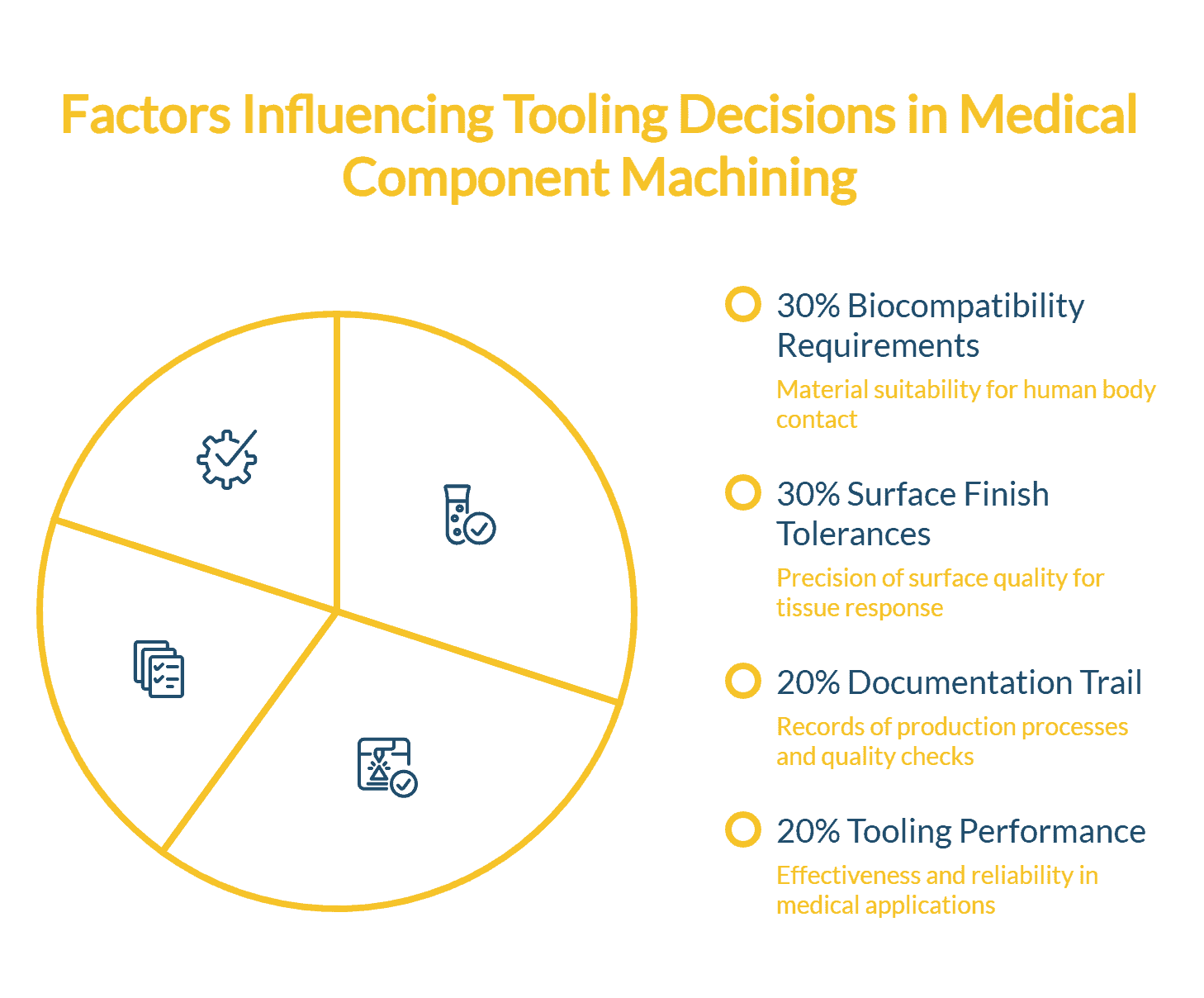
That environment changes how tooling decisions get made. Material selection is constrained by biocompatibility requirements, not just machinability ratings. Surface finish tolerances are driven by tissue response and fluid dynamics, not just visual quality checks. And the documentation trail behind every production run needs to be clean. Tooling that works well enough in other applications is genuinely not good enough here.
The materials medical machinists deal with every day
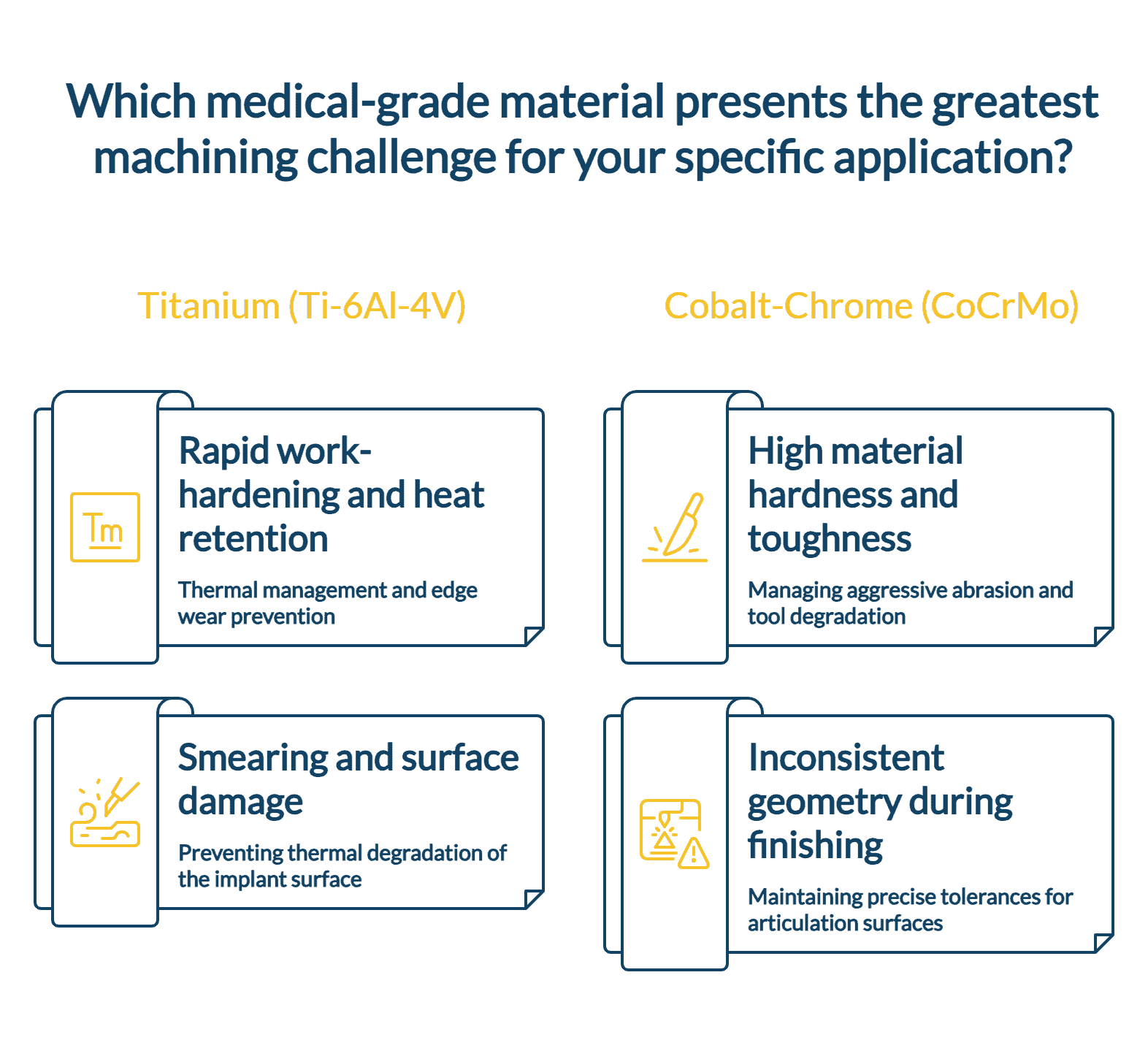
The most common materials in medical device manufacturing sit near the top of the difficulty ranking for machinability: implant-grade titanium (Ti-6Al-4V ELI), cobalt-chromium alloys (CoCrMo), hardened stainless steels (316L, 17-4 PH), and medical-grade PEEK and other engineering polymers. Each presents a specific challenge at the cutting edge.
Titanium work-hardens rapidly during cutting. It also has low thermal conductivity, meaning heat generated at the cutting zone stays at the edge rather than dispersing into the chip or the workpiece. This accelerates edge wear and, in the worst case, causes smearing or surface damage that compromises the implant surface. Tooling for titanium needs sharp edge prep, appropriate helix for the operation, TiAlN or AlCrN coating for heat resistance, and careful coolant management to keep temperatures from spiking.
Cobalt-chrome is abrasive. CoCrMo alloys are hard, tough, and work-harden during machining in ways similar to stainless, but more aggressively. Edge wear accelerates quickly if the carbide grade and geometry are not appropriate for an abrasion-dominant wear environment. Surface finish requirements are often extremely tight for implant articulation surfaces, which means the tool needs to maintain a consistent geometry all the way to final dimension, not just approximate it.
Stainless steels in medical grades, particularly 17-4 PH in the H900 condition, are hard and gummy. Built-up edge and adhesion are primary concerns. Sharp edge prep with TiAlN or AlCrN and proper chip evacuation are the most reliable path to consistent results.
Why surface finish requirements are not negotiable
In most machining environments, a surface finish that is slightly above spec gets accepted with a note. In medical device manufacturing, that is typically not an option. For implant surfaces, Ra tolerances are tied to clinical outcomes: rough surfaces can promote bacterial biofilm accumulation, affect osseointegration rates for bone-anchored implants, or alter fluid dynamics in cardiovascular components. The finish tolerance is not an arbitrary engineering specification. It connects directly to how the device performs in use.
Achieving consistent Ra values across a production run requires a tool that maintains its edge geometry predictably across the full tool life. Inconsistency in edge condition, whether from premature wear, thermal damage, or coating failure, shows up in the finish data. For medical work specifically, this makes tool life consistency at least as important as maximum tool life: you need to know what the tool will do at the 80th part, not just the first.
Where standard tooling runs out of precision
Most of the applications where standard tooling falls short in medical manufacturing come down to one of three factors: geometry that is not optimized for the material, diameter tolerances that are not tight enough for the feature, or tool life variability that is too wide for controlled production.
Custom solid carbide tools allow geometry, carbide grade, coating, and edge prep to be matched specifically to the material and operation. For a reaming application in CoCrMo where bore diameter must hold .0002″ tolerance and finish must meet a specific Ra across a production run of implant components, a custom reamer ground to those requirements on appropriate carbide with the correct coating is the practical solution. A catalog reamer is designed for a distribution of applications. A purpose-built reamer is designed for yours.
Documentation and quality systems
Medical device manufacturing is regulated. Parts produced for implantable devices typically require traceability through the supply chain, including the tooling program. Having a manufacturing partner that operates under a recognized quality system is not just a convenience; in many cases it is a requirement for the supply chain to function.
Epic Tool is ISO 9001:2015 certified and operates under the Controlled Goods Program at our manufacturing facility in Stoney Creek, Ontario. If your production runs require quality documentation that extends to your tooling supplier, our system supports that. If you are dealing with a difficult medical machining application where standard tooling is not delivering the consistency you need, contact our team.