A 4 flute end mill goes into a full width slot in 6061. Thirty seconds later the flutes are packed solid with welded aluminum, the finish is torn, and the tool is scrap.
Nothing was wrong with the cutter. It was a good tool, correctly ground, running sensible speeds and feeds. It simply had nowhere to put the chips.
Flute count is one of the first decisions made when selecting a cutter and one of the least examined. Most shops default to a 4 flute for steel and a 2 flute for aluminum, which is right often enough that the reasoning behind it never gets tested. This post covers what flute count actually controls, how to match it to material and operation, the feed rate mistake that follows a flute count change, and what to do when the standard options do not fit the part.
What Flute Count Actually Controls
Every end mill is a compromise between two things competing for the same space inside a fixed diameter.
There is the core, the solid column of carbide running down the centre of the tool. There are the flute valleys, the empty channels cut into it. Carbide you add to one, you take from the other.
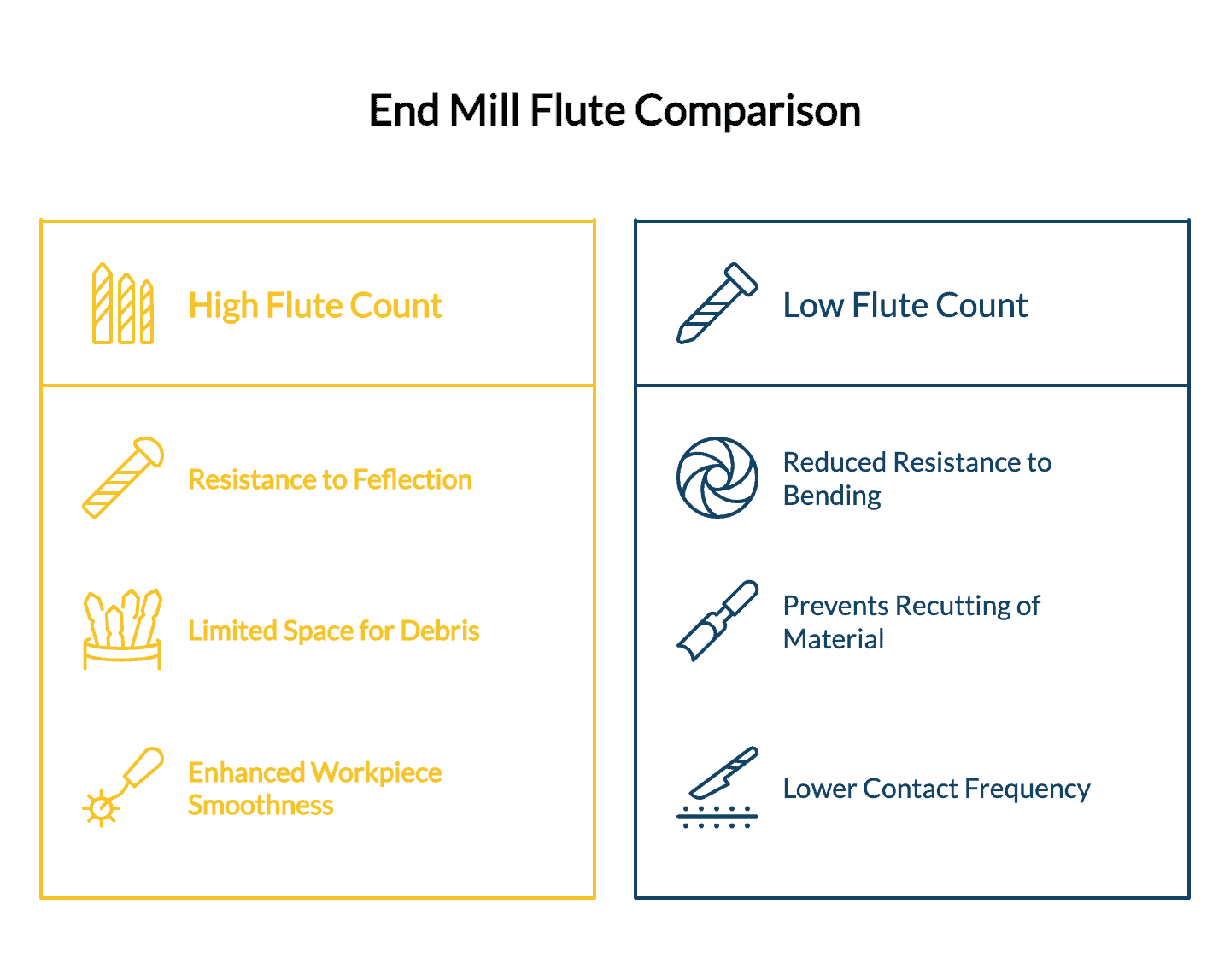
More flutes means a larger core and more cutting edges. That gives you rigidity, resistance to deflection, more edges engaged per revolution, and a better finish. Fewer flutes means bigger valleys and room for chips to leave the cut before they get recut, packed, or welded.
That is the entire trade-off. Strength and finish on one side, chip clearance on the other. Every recommendation below is an application of that one rule.
It is worth adding that core diameter is not determined by flute count alone. Flute depth, helix angle, and the overall design of the tool all affect it, which is why two 4 flute cutters from different manufacturers can behave differently in the same cut.
Flute Count by Material
Material determines what kind of chip you are producing, and the chip determines how much room you need.
Aluminum, brass, copper, and plastics. These produce long, thick, continuous chips that need somewhere to go. Two and three flutes dominate here. The 3 flute high helix cutter has become the modern standard for CNC aluminum work because it keeps most of the chip clearance of a 2 flute while adding core strength and allowing higher feed rates. Polished flutes matter as much as flute count, since built up edge is the failure mode.
Mild and carbon steel. Steel chips are shorter and more brittle, so evacuation stops being the constraint and rigidity takes over. Four flutes is the workhorse. The load spreads across more edges, the cut runs smoother, and the finish improves.
Stainless steel. Four flutes, sometimes five. Stainless work hardens when the tool rubs, so the priority is keeping the edge cutting rather than skidding. More edges also help spread heat.
Titanium. Four to six flutes depending on strategy. Heat is the whole problem, and the answer is usually lower radial engagement with a higher flute count rather than heavy conventional cuts.
Hardened die steel above 45 HRC. Five, six, or more. Chip volume is small, so valley space is nearly irrelevant. What matters is a massive core and edges strong enough to survive the cut. This is standard territory for mold and die work, where finishing passes in hardened material demand rigidity above all else.
Carbide grade interacts with all of this. A high flute count only helps if the substrate can take the load, which we cover in the role of carbide grades in end mill selection.
Flute Count by Operation
Material sets the starting point. The operation adjusts it.
- Full width slotting. Drop to 2 or 3 flutes regardless of material. In a slot the chips have exactly one exit route, straight up the flutes, and there is no room for error. This is the single most common flute count mistake in machine shops.
- Roughing. Lower flute count. High chip volume needs valley space.
- Profiling and side milling. The material default is usually correct.
- Finishing. Add one or two flutes above your material default. Chip volume is small and more engaged edges give a better surface.
- Deep pockets. Lower flute count than you would use in an open cut. Chips have further to travel and more chances to recut on the way out.
The Feed Rate Trap Nobody Mentions
Here is the part that catches experienced people.
Feed rate is calculated as RPM multiplied by flute count multiplied by chip load. Flute count is inside that equation. Swap a 3 flute cutter for a 4 flute cutter of the same diameter and leave the feed rate untouched, and every cutting edge is now taking twenty five percent less material than it was.
That sounds harmless. It is not. Below a certain thickness the edge stops shearing material and starts rubbing against it, which generates heat with no chip to carry it away, hardens the surface ahead of the tool, and burns the edge. Reduce chip load far enough and a perfectly good cutter fails for reasons that have nothing to do with how hard it was working.
Any flute count change needs a matching feed rate change. If you moved from 3 to 4 flutes, feed rate needs to go up by a third to keep the same load per tooth.
Odd Flute Counts, Variable Helix, and Chatter
Three and five flute cutters do something a 4 flute cannot.
Evenly spaced flutes on an even count put cutting edges directly opposite each other, which can reinforce vibration at certain RPM bands. Odd flute counts break that symmetry. Many modern 3 and 5 flute tools go further with variable helix or variable pitch geometry, where the spacing between edges is deliberately irregular so no single harmonic can build.
If you are fighting chatter on a lighter machine or on a long reach setup, changing flute count and geometry is often more effective than dropping the feed. Reducing feed to quiet a chattering tool tends to push the chip load down into the rubbing zone, which trades one problem for a worse one.
When the Standard Flute Counts Do Not Fit
Flute count is one variable in a geometry that also includes helix angle, core taper, corner radius, edge prep, flute length, and reach. Standard tooling fixes all of those at once and asks the part to accommodate them.
Sometimes the part will not. A deep pocket with a tight corner radius and a hardened floor may need a flute count for rigidity and a valley volume for evacuation that no catalogue tool provides together. That is a geometry problem, and no adjustment on the control will solve it.
This is where custom carbide tooling earns its place. We grind solid carbide end mills on 5 and 6 axis CNC equipment in Stoney Creek, using sub micron carbide grades, and we also carry the YesTool and CERATIZIT standard lines when a stock tool is the right answer. For shops across Hamilton, Burlington, and the GTA, both options come from the same floor without waiting on a border crossing.
Choosing Flute Count Without Guessing
The short version:
- Flute count trades chip clearance against core strength and finish. That is the whole decision.
- Soft and gummy materials need valley space. Hard and ferrous materials need core.
- Slotting overrides the material default. Drop to 2 or 3 flutes every time.
- Finishing passes can carry more flutes than roughing passes in the same material.
- Change flute count and you must change feed rate, or you have quietly changed your chip load.
- Odd flute counts and variable helix geometry are chatter tools, not marketing.
If you are working through a tool selection problem, our guide to choosing the right end mill covers the rest of the geometry, and why carbide end mills keep breaking works through the failure modes.
Not sure which flute count your application needs? Contact us and we will work through it with you.
Frequently Asked Questions
How many flutes should I use for aluminum?
Two or three. Aluminum produces long continuous chips that need room to clear, and a high flute count packs and welds material into the valleys. Three flute high helix cutters are the modern standard for CNC aluminum because they add core strength and feed rate capability over a 2 flute without giving up much chip clearance.
Can I use a 4 flute end mill for slotting?
In a full width slot, no, especially not in aluminum. The chips have only one exit path and a 4 flute cutter does not give them enough room. Use 2 or 3 flutes for full width slotting regardless of material, or use a lighter radial engagement strategy such as trochoidal milling instead of a straight slot.
Does adding flutes let me feed faster?
Yes, but only if you adjust the feed rate. Feed rate equals RPM times flute count times chip load, so more flutes support a higher feed rate at the same load per tooth. If you increase flute count and leave the feed rate alone, you have reduced the chip load instead, which shortens tool life rather than extending it.